My former website, StockMoHistory, is no longer online.
However, this blog was my original site.
Blogposts that I wrote in 2014 can be found at Algonkian Church History (2014 Posts)
Wednesday, January 8, 2014


Friday, December 13, 2013
Navaho Star Wars is Available on DVD

I am so happy for the Navajo people!
Although it is still spoken, the language of the Navajo people, Dine' has been falling into disuse.
So what did the Navaho Native Mueum do about it?
They redubbed the orignal (1977) Star Wars movie (aka A New Hope) into Dine'!
I first read about it at Indian Country Today.

At the premier, one museum official said "the most important thing that happened tonight was...people....were...enganged without feeling they were, you know, in a lesson."
The voice actor for Han Solo told a reporter that the youth of the tribe would be speaking more Navajo/Dine' because of the film.
I cannot say enough about what the movie already means to the Navajo people, but I also feel I need to point out that this film - with English subtitles - was shown "off the rez" and the critics at Roger Ebert's Balder and Dash felt it was - in some ways - an improvement over the English language version. That is high praise.
What a wonderful, feel-good story!
And now "Navajo Star Wars" is available on DVD!!!
Read about it in the Navajo Times.
Wednesday, December 4, 2013
Announcing my book: Proud and Determined
As you may know, Algonkian Church History has been an advertising-free, not-for-profit blog for five full years (with more than 300 posts).
But changes may be coming. I'm working on getting a different kind of blog because I have something to sell: a book!

But changes may be coming. I'm working on getting a different kind of blog because I have something to sell: a book!

Click on the image to enlarge.
I'm the author of Proud and Determined: A History of the Stockbridge Mohicans, 1734-2014.
But the cover that you see above was a team effort. When you need help with something, you find out who your true friends are. So I'd like to publicly thank the people involved with "my" book cover: Bart Putzer, Vicki Bowman Stevens, Doug Rand, and John Martin.
John's father created the Many Trails symbol and he gave me permission to use a photo of it. The photographer is Doug Rand, a friend of John's. And Vicki, the "cover model," is John Martin's step-daughter (if you want to be technical about it, but I don't think John and Vicki use the "step" word).
Finally, Bart Putzer put it all together and designed the cover. Hard to believe he had never designed a book cover before!
Tuesday, November 26, 2013
Learn the Yupik Alphabet Painlessly
Yupik isn't part of the Algonkian language family, but I couldn't resist embedding this charming video.
Thanks Jackie!
Thursday, November 7, 2013
Kid Lit about Native Americans: Rethinking Columbus and Other Titles

It is a good thing that these books come from a variety of genres. Nevertheless, this blog is about history, so I won't tell you about any Native science fiction or other genres that aren't specifically about history. We'll stick to history here.
That leaves just two books, both of which are aimed at high school youth. The first one, with its lesson plans and attention to the educational process, might be aimed at teachers as much as it is at students.
Rethinking Columbus: The Next 500 Years, 2nd Edition
Bill Bigelow and Bob Peterson, editors.
The first edtion of this book made a big splash in 1991.
Oddly, the second edition (published in 2003) is not available on Amazon, but you can purchase it from Rethinking Schools.
The other book is good for teens but also a good read for adults:
Code Talker Stories by Laura Toho
The author's father, Benson Toho was a code talker and the book is based on interviews with the surviving code talkers. Includes photos by Debra O'Grady.
Available at Treasure Chest Books
Tuesday, October 22, 2013
An Update on Electa Quinney, The first Female Schoolteacher in Present-day Wisconsin
 |
Volume XV of Wisconsin Historical Collections contains a letter from an Augustus T. Ambler. The purpose of that letter was to report the death of the Stockbridge Mohican's missionary, Jesse Miner, to the philanthropical society that supported his work. Miner died in March of 1829.
In that same letter, Augustus T. Ambler reports that he had been teaching for three months and had also been sick for three weeks. Ambler adds that "Electa Quinney, a competent native teacher, will probably take charge of the school this summer."
And she did. Electa Quinney had taught for six years at New Stockbridge, New York and after arriving at Statesburg (which is now Kaukuana, Wisconsin), she taught the children of her people for one more term, in the summer of 1829.
I pieced these things together at about the same time that I got access to Electa Quinney's only known biography, an unpublished college term paper written by Annie Paprocki in 1999. Paprocki says the same thing: Augustus Ambler taught in the winter of 1828-1829 and Electa Quinney took over the teaching duties the next term, before being replaced by Jedidiah Stevens.
Here's a somewhat amusing sidenote:
Out of an understandable eagerness to point to positive role models (or to make money on the web), people need to be careful not to make false claims. I came across a webpage that even claims Electa Quinney was South Dakota's first schoolteacher. Correction: Electa Quinney never even lived in South Dakota. Also, there is no Kaukauna in South Dakata.
Anyway, to wrap it up, I think Annie Paprocki was right to conclude that Electa Quinney is still a good role model despite not having taught school in 1828. You don't have to be the first one to do something to be a good role model. Electa Quinney was a Christian schoolteacher, and later a wife and mother at a time and place where nothing came easy - especially not to Indians.
Wednesday, October 16, 2013
A Milestone - Algonkian Church History's 300th post
A lot of Algonkian Church History posts lead readers to other sites or to books or other resources.
But today - with our 300th post - Algonkian Church History is honoring itself!
According to Google, ACH has received over 80,000 page views since it began on November 5th, 2008. As the creator of almost all of the posts, I've been surprised when some posts are viewed by many - while others that I've worked hard on are seen by only a few.
Anyway, here's a list of some ACH posts that were popular, and others that deserve special mention:
Most Viewed Posts:
3rd Place: Occom's Short Narrative of My Life (1735 views to date)
2nd Place: Bury My Heart at the Monastery: The Menominee Takeover of the Novitiate
This well-illustrated post includes links to relevant sites. The standoff between a dissident faction of Menominees and the federal government was probably the most newsworthy event for Wisconsin Indians in the 1970's. The post now has 2039 views.
1st Place: The High Point of Stockbridge Calvinism
Don't get me wrong, this was not a bad post, but I suspect that it has received 2405 views partly by accident. Many web surfers undoubtedly came to this post by clicking on the symbol you see below on Google images:

Least Viewed Post:
NPR Asks Who Is an Indian? The once-broken link to the NPR segment now works. And, as before, this post is graced with a photo of a reader of this blog, Darren Kroenke.
Most Humorous Post:
Who Taught the Stockbridge Indians to Moon? This one needs no introduction.
Most Controversial Post:
Racial Identity Among the New York Indians: Chris Geherin Looks at "New Guinea"
I was thrown out of an online community after this post appeared. Even now, some people who self-identify as Indians are not willing to accept that they may also have some African blood. Get over it!
Most Viewed Series of Posts:
The New York Indian Removal Series Thanks to a link from the New York History blog, this series of twenty posts had a reasonably large audience.
But today - with our 300th post - Algonkian Church History is honoring itself!
According to Google, ACH has received over 80,000 page views since it began on November 5th, 2008. As the creator of almost all of the posts, I've been surprised when some posts are viewed by many - while others that I've worked hard on are seen by only a few.
Anyway, here's a list of some ACH posts that were popular, and others that deserve special mention:
Most Viewed Posts:
3rd Place: Occom's Short Narrative of My Life (1735 views to date)
2nd Place: Bury My Heart at the Monastery: The Menominee Takeover of the Novitiate
This well-illustrated post includes links to relevant sites. The standoff between a dissident faction of Menominees and the federal government was probably the most newsworthy event for Wisconsin Indians in the 1970's. The post now has 2039 views.
1st Place: The High Point of Stockbridge Calvinism
Don't get me wrong, this was not a bad post, but I suspect that it has received 2405 views partly by accident. Many web surfers undoubtedly came to this post by clicking on the symbol you see below on Google images:
Least Viewed Post:
NPR Asks Who Is an Indian? The once-broken link to the NPR segment now works. And, as before, this post is graced with a photo of a reader of this blog, Darren Kroenke.
Most Humorous Post:
Who Taught the Stockbridge Indians to Moon? This one needs no introduction.
Most Controversial Post:
Racial Identity Among the New York Indians: Chris Geherin Looks at "New Guinea"
I was thrown out of an online community after this post appeared. Even now, some people who self-identify as Indians are not willing to accept that they may also have some African blood. Get over it!
Most Viewed Series of Posts:
The New York Indian Removal Series Thanks to a link from the New York History blog, this series of twenty posts had a reasonably large audience.
Monday, October 14, 2013
Marker for Jacob Konkapot and Hendrick Aupaumut

As of October 11, 2013 - that is three days ago as I write - Melinda, a recent transplant to the state, completed her goal of visiting - and blogging on - all 537 Wisconsin Historical Society markers. As a matter of fact, Melinda went way beyond her goal and visited a grand total of 1754 Wisconsin historical sites!
Melinda has a late-stage cancer diagnosis, so it was that much more important to her to finish her tour within the roughly 18-month time-frame that she set for herself. Read her story here.
Melinda was only a few weeks into her project when she blogged on the marker that was erected on behalf of H. Aupaumut and J. Konkapot. This is what that post looks like.
Congratulations Melinda! Rest in Peace Captain Hendrick and Mr. Konkapot!
Monday, October 7, 2013
High Price for Hopkins' Historical Memoirs'

You can see that this book has a long title.
Historical Memoirs, Relating to the Housatunnuk Indians: Or, An Account of the Methods Used, and Pains Taken, for the Propagation of the Gospel Among that Heathenish Tribe, and the Successes Thereof, Under the Ministry of the Late Reverned Mr. John Sergeant: Together, With the Character of that Eminently Worthy Missionary; and an Address to the People of this Country, Representing the very Great Importance of Attaching the Indians to their Interest, not only by Treating them Justly and Kindly, but by Using Proper Endeavors to Settle Christianity Among them.
Perhaps you can see that it was published in 1753. That is four years after John Sergeant, the first missionary to the Housatonic Mohicans (eventually known as the Stockbridge Mohicans) died.
It is a very important book, partly because the author, Samuel Hopkins, had access to John Sergeant's journals which were later lost. The book also contains descriptions of things like maple syrup that white people don't seem to have been aware of before that point. The Indians boiled it down into a kind of sugar.
I got a chance to read a legitimate copy of this old book at the Wisconsin State Historical Society ten years ago. As I turned the pages it was literally falling apart - that is what happens with a book that is more than two hundred years old.
Anyway, a copy of this book brought $5,856 in a 2010 auction.
Sounds like an awful lot, until you realize that it was purchased for $10,500 in 2001!
Friday, September 27, 2013
Battle of the Thames Bicentennial:Tenskwatawa, Tecumseh and Harrison Struggle over the Old Northwest

October 5th, 2013 marks the bicentennial of the Battle of the Thames. In a series of posts on this blog you may have already read how the Shawnee Indian Lalawethika became a prophet and how he rose to prominence among the more anti-American Indians in the Old Northwest, first by officiating in a witch purge and later by predicting a solar eclipse. White people at the time and historians until recently have thought of the Native resistance movement as being a primarily political one led by the prophet’s brother, Tecumseh. However, in recent years, historians like Alfred Cave and Adam Jortner are putting Tecumseh’s brother front and center. Their research indicates that the Native resistance movement or city-state if-you-will was primarily religious or spiritual in nature – at least up until 1809 when William Henry Harrison’s aggressive conduct forced the Indians to defend their territory. But until then the movement was led by Tecumseh’s brother, Tenskwatawa, alias Lalawethika.
Let’s pick up the story after Lalawethika successfully predicted the solar eclipse of June 16, 1806. His followers had already established a town near the remains of Fort Greenville in Ohio, but the prophet asserted that the Master of Life – his name for the Great Spirit - told him to construct a new settlement in present-day Indiana. The move was made in 1808. At roughly the same time as his base of operations moved from Greenville to Prophetstown, Lalawethika changed his name to Tenskwatawa. Historian Adam Jortner doesn’t doubt that the Shawnee prophet was motivated by religion. At the same time, Jortner (114) observes that Prophetstown, at the confluence of the Wabash and another river that whites mispronounced as “Tippecanoe,” was ideally located from a secular viewpoint. By moving from Ohio, to Indiana Territory, Tenskwatawa was moving onto William Henry Harrison’s turf; Harrison was the governor of Indiana Territory. Harrison had denounced the prophet after he put four Delaware Indians to death in the witch purge of 1806, but the two men got together soon after Prophetstown was established and Harrison actually took a liking to Tenskwatawa.
However, Harrison was more concerned about his career than with making friends with Indians. He used a number of shady tactics to effect the 1809 treaty of Fort Wayne, in which three million acres was ceded to the United States by Miami, Delaware, Shawnee, Kickapoo and Potawatomie chiefs (Jortner, 160-164). Harrison had recognized the local chiefs as owners of the land and that was precisely what Tenskwatawa and his followers objected to. As they saw it, Harrison was taking advantage of Indians by bargaining with local chiefs. The all-Indian confederacy they were building was intended to force the United States to deal with all the tribes collectively, rather than allowing them to play tribes against each other. So Harrison’s Fort Wayne treaty of 1809 was the thing that turned Prophetstown from a primarily religious or spiritual movement or city-state into a primarily political and military one. Tenskwatawa threatened to not allow the United States to survey the 1809 treaty lands and in 1810, his brother Tecumseh personally threatened Harrison that the movement would ally with the British if the treaty wasn’t nullified (Langguth, 167). In November, 1811 Harrison brought a thousand soldiers to Prophetstown and the result was the Battle of Tippecanoe. With about sixty men dying on each side, it wasn’t the rout that Harrison’s supporters later claimed.
At this point Harrison’s political opponents in Washington launched an investigation. In an earlier post, I explained historian Adam Jortner’s research about how William Henry Harrison got away with his belligerent conduct towards the Indians of the Old Northwest. To make a long story short, there were already tensions with Britain and a common, but erroneous, belief that the British were a bad influence on the Indians. So Harrison got away with his aggressive tactics by making them just one part of the push for war.
Tecumseh and his warriors teamed up with the British forces. In taking Fort Detroit, they declared all of Michigan Territory theirs. However, within a few months, the British supply chain was cut off due to Admiral Oliver Hazard Perry’s naval victory on Lake Erie. This prompted the British General Henry Proctor to plan a retreat. When Tecumseh got word of Proctor’s plans he was outraged and made a valiant speech. After a few days the two leaders came to a compromise: they would only retreat to the nearest defensible location. That was the Thames River. That retreat meant giving up Michigan and many of Tecumseh’s warriors – who were fighting specifically for Michigan - left at that point.
When the Battle of the Thames started, Tecumseh’s forces were on high ground overlooking a swamp and the British were somewhat protected by the river. In what Canada’s Battle of the Thames Bicentennial website calls a “bold and unconventional move,” Harrison unleashed his cavalry on the British, who - being outnumbered and unmotivated - spared their own lives by surrendering or fleeing. Tecumseh and many of his most militant warriors, fought to the death, however, in a decisive victory for the United States.
Although Tenskwatawa fled into Canada, the Battle of the Thames did not put an end to his movement as many have believed. As of 1816, he still had a large following of warriors. But when many of them decided to rebuild Prophetstown, he was afraid to go back with them (Cave, 138). He later worked out a deal with the United States and died in a Shawnee community in present-day Kansas in 1836.
References
Cave, Alfred A. Prophets of the Great Spirit: Native American Revitalization Movements in Eastern North America. Lincoln: University of Nebraska Press, 2006.
Jortner, Adam Joseph. The Gods of Prophetstown: The Battle of Tippecanoe and the Holy War for the American Frontier. Oxford: Oxford University Press, 2012.
Jortner, Adam Joseph. The Gods of Prophetstown, online interview: http://www.amazon.com/The-Gods-Prophetstown-Tippecanoe-American/dp/0199765294 accessed on 8/23/2012.
Langguth, A. J. Union 1812: The Americans Who Fought the Second War of Independence. New York: Simon & Schuster, 2006.
Thursday, September 12, 2013
Is Short Hair More "Civilized"? (The U.S. Government Thought So)
What does it mean to be "civilized"? It is a question we no longer ask today because we've become sensitive to what happens when one group of people - a group that assumes their ways are better - interferes with another group and tells them what to do. But the word "civilized" was still being used in United States government documents at the beginning of the last century.
 This comes from Slate's historical blog, The Vault
In case you cannot read the small text, here is a transcript:
This comes from Slate's historical blog, The Vault
In case you cannot read the small text, here is a transcript:
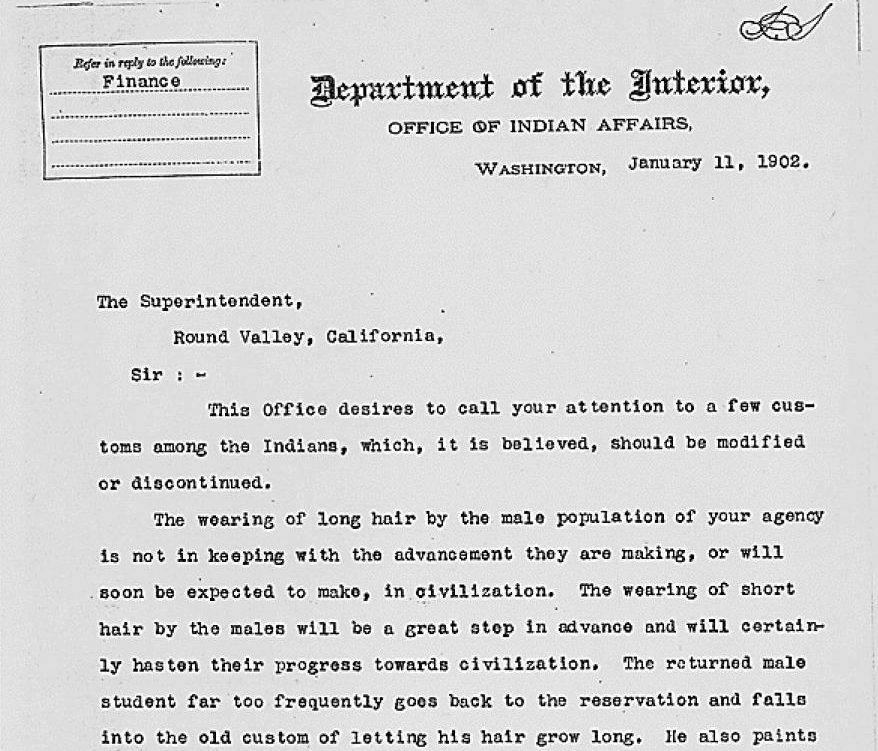
This Office desires to call your attention to a few customs among the Indians, which, it is believed, should be modified or discontinued. The wearing of long hair by the male population of your agency is not in keeping with the advancement they are making or will soon be expected to make, in civilization. The returned male student far too frequently goes back to his reservation and falls into the the old custom of letting his hair grow long....The letter continues for another page and a half, if you find it outrageous or outrageously quaint, you may want to read the post that goes with it.
Tuesday, September 3, 2013
Video: "Christianity and the Native American Religious Experience," a lecture by Linford Fisher
In only fourteen minutes, Linford Fisher gives a broad overview of a topic that goes far beyond Algonkian Church History.
Subscribe to:
Posts
(
Atom
)